
Trout fishing is a favorite pastime for many anglers in the spring and year round. Anglers who seek this sleek quarry vary from the veteran fly fisher to the opening day crowds. We’ll discuss some of the techniques used to catch trout and then we’ll go into specifics on where the local hot spots are.
Trout Fishing in Whatcom and Skagit Counties
Fishing for trout in around Bellingham in Whatcom and Skagit counties is a favorite pastime for many in the Spring. Most lakes open for trout fishing the last Saturday in April, and streams open June 1st. However, some lakes such as Fazon, Squalicum, Clear, Pass, Big Lake, and Lake Cavanaugh are open year round to fishing.
A substantial number of the many lakes throughout Whatcom and Skagit Counties receive hatchery stocks of fish from the Washington department of Fish and Wildlife. Some of the popular species of fish that are stocked in our lakes are Rainbow trout, Triploid Rainbow trout which are stocked at roughly 1-1.5lbs each, Cutthroat trout, and Kokanee. The vast majority of stocked trout fall into the category of ‘catchables’, or 10 to 12 inch fish. A few popular lakes in Whatcom County for opening day are Lake Padden, Silver Lake, Lake Terrell, and Cain Lake in Whatcom County. These lakes all receive good stocks of hatchery fish just prior to opening day so the fishing is usually very hot. Expect to see crowds and lots of anglers out with their kids for the day.
According to the WDFW, stocked hatchery fish will remain in the upper 3-5 feet of water for the first few weeks after they are introduced to the lake. This means that on opening day and for the weeks following it is best to fish troll shallow, or use floats to keep your bait or lure near the surface. After a few weeks they will drop down towards the bottom after cueing in on natural food sources. It is then best to fish deep near the bottom using deep trolling methods, sinking fly lines, or lead weights to get the bait down to the bottom. (http://wdfw.wa.gov/fish/plants/)
Fishing Flotation Devices
There are many different ways anglers choose to fish for Trout. In streams, anglers may hike up and down the bank, or drift downstream in drift boats, pontoon boats, or motorized jet sleds. In lakes, anglers choose from canoes, kayaks, pontoon boats, power boats, and float tubes. Each type of flotation device has it advantages and disadvantages, so it is advised that if you can try them out before purchasing one it is best to do so. Local shops like Yeager’s Sporting goods carry a selection of boats that anglers can check out and see the different features.
Trout Fishing Techniques
Some of the different techniques employed to catch trout in the lakes and streams include trolling with spinners and spoons, fishing bait with a bobber or on the bottom with lead, casting spinners and spoons and fly fishing. The techniques you use will most likely be dictated by whether you are fishing from a boat or not.
Popular techniques for bank fishermen are to use bait such as powerbait, eggs or night crawler worms with a leader attached to a lead weight. This rig lets the bank angler cast long distances out and while the lead settles to the bottom the bait floats and presents itself to the fish. This technique is also a popular method for kids and fishing beginners as it is easily rigged and fished and generally produces good results. The rig uses a sliding lead weight on the main line which is tied to a swivel. A 12-36” leader is tied to the swivel to a bait holder hook or treble hook. Powerbait can be balled up and smooshed onto the hook or other bait like worms can be fished with this rig.
Alternatively, if the angler is fishing from a boat and prefers to troll, they can simply use a spoon or other attractor rig tied to a leader behind some weight. Trolling speeds vary depending on the time of day and other conditions so it’s advised to vary your speed and fishing depth until you begin to catch fish consistently. If it’s hot out, it’s likely that the trout will be lying in the deep areas along the bottom seeking cooler water.
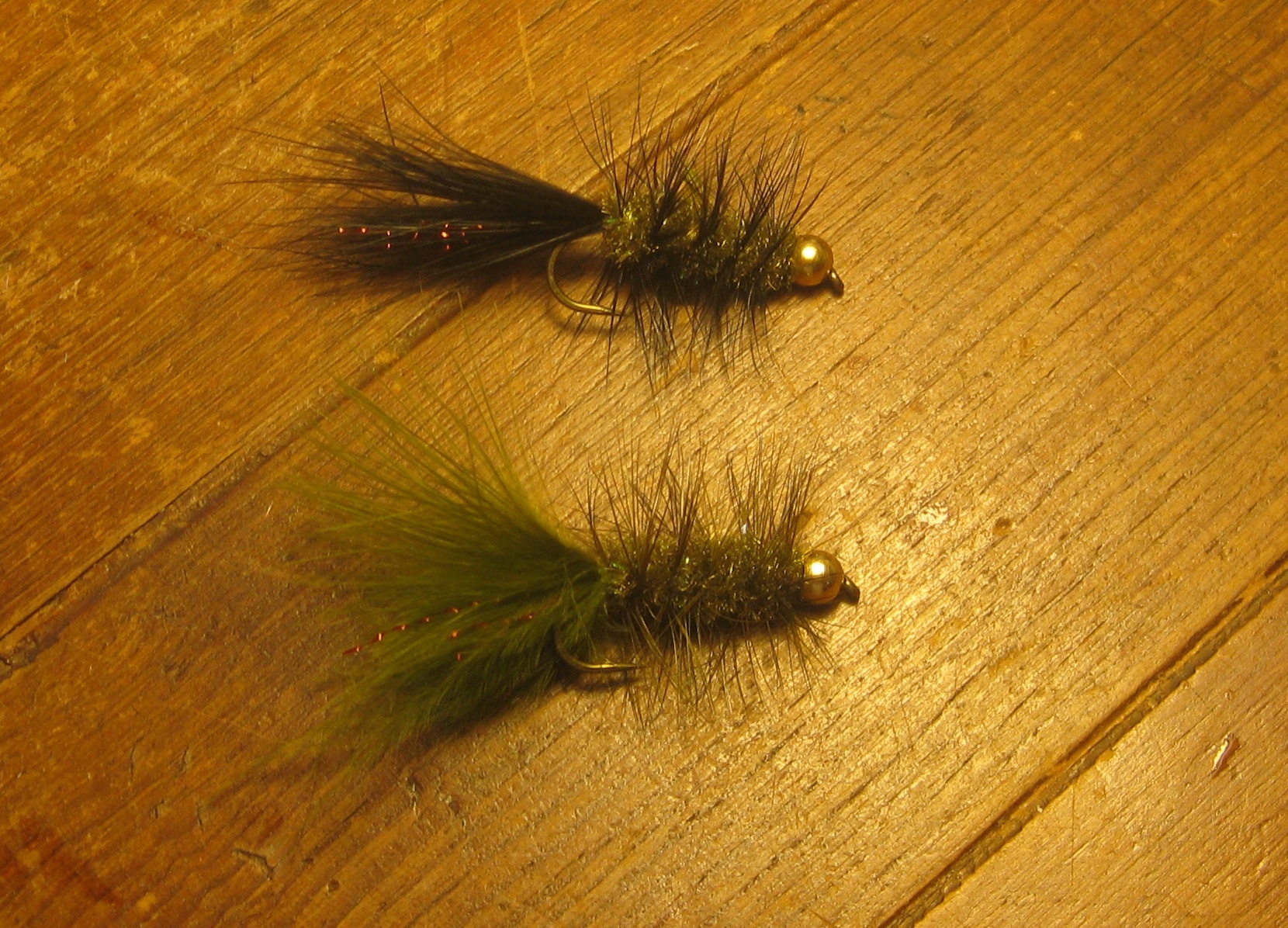
Another popular method for trout seekers is fly fishing. There are a variety of different techniques and flies to use for catching trout, so I will just name a few. First, fly fishermen will use either a floating or a sinking line to present their fly to the fish. If the angler is imitating a flying insect she will select a floating line, and a dry fly to imitate a caddis, mosquito, or any other flying insect that may be present. The fly is cast out and either dead drifted or skated across the surface to entice a trout to rise and take the lure in its mouth. When fly fishing a sinking line the angler selects a nymph or streamer pattern that usually imitates a nymph, leech, or baitfish. Popular methods for fishing these is by trolling or casting and retrieving in short erratic motions.
Some popular dry fly patterns include the Elk Hair Caddis, Humpy in various colors, Adams, Royal Wulff, Blue Wing Olive, and the Renegade. Popular wet patterns include the Prince nymph, Hares Ear nymph, Pheasant Tail, Muddler Minnow, and the all time favorite Woolley Bugger. Each fly can be found in a variety of colors and sizes.